



Hot Work Versus Cold Work for Grinding and Cutting: What Changes in Practice?
Preparing a weld for inspection, removing corrosion or cutting through metal may seem like straightforward tasks. On an industrial site, however, the surrounding conditions largely determine how much preparation is needed. This is particularly relevant where flammable substances or ATEX zones are involved.
The choice between hot work and cold work affects more than the tools used. It can also change permit requirements, worksite preparation and scheduling. A suitable cold work method can reduce the additional measures required specifically for hot work, while the assessment of the overall job remains the starting point.
What Is the Difference Between Hot Work and Cold Work?
Hot work covers activities that can introduce an ignition source through flames, heat or sparks. Alongside welding and thermal cutting, conventional grinding can fall into this category. An open flame does not have to be present for an activity to be treated as hot work.
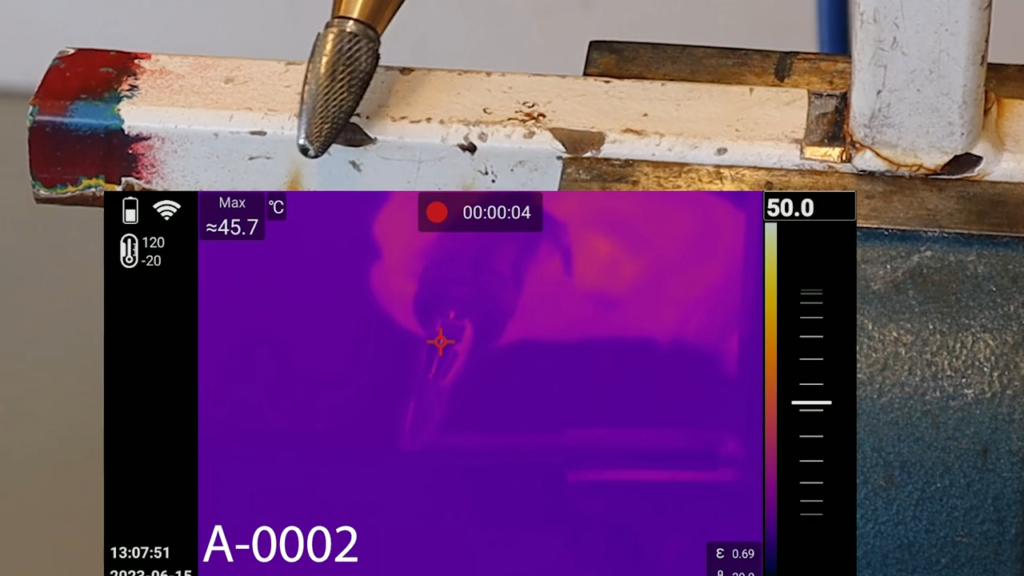
Cold work uses a method that, within its specified conditions of use, allows the task to be performed without the ignition sources associated with hot work. For Allmet, this involves specifically developed and certified grinding and cutting solutions.
“Cold” does not mean that no friction or heat is generated. It refers to the behaviour of the equipment during operation and the conditions under which it has been assessed. A pneumatic grinder fitted with an arbitrary disc is therefore not automatically a cold work solution. The combination of tool, disc or burr, accessories and application matters.
Allmet offers grinding and cutting tools certified as cold work solutions for ATEX gas zones 1 and 2. Always check the certification and conditions of use for the specific equipment selected.
What Changes on Site?
The main differences become apparent before grinding or cutting begins.
| Aspect | With hot work | With a suitable Allmet cold work solution |
|---|---|---|
| Permits and authorisation | Apply for a hot work permit, arrange the associated controls and wait for authorisation | A hot work permit may no longer be required when the method is accepted as cold work on site |
| Worksite preparation | Remove or protect combustible materials; install fire blankets, spark screens or a hot work habitat where required | Less setup and screening may be needed as measures specifically addressing hot grinding sparks and heat can be removed |
| Fire watch and post-work checks | May require additional personnel during and after the task | May be removed when required solely because of hot work |
| Simultaneous operations | Nearby activities may need to be restricted or interrupted due to sparks and fire risk | More opportunities to carry out activities simultaneously, following assessment of how they affect one another |
| Production and downtime | Hot work requirements may create the need for an additional shutdown or a specific maintenance window | More opportunities for maintenance during operation, where the equipment condition and task allow |
| Overall completion time | Time is needed for hot work preparation, authorisation and any post-work fire watch, in addition to the task itself | Time savings are possible through reduced preparation and waiting time around the actual work |
General work preparation and risk assessment apply to both methods. The benefit of cold work lies in reducing the additional organisation and controls required specifically for hot work. Which measures can be removed is determined during site authorisation.
Less Preparation Specifically for Hot Work
Hot work preparation may involve removing or protecting combustible materials, controlling the spread of sparks and arranging a fire watch. A cold work method can remove some of these requirements.
This can make a considerable difference for a small maintenance task. The actual grinding or cutting may take relatively little time, while preparation and authorisation account for much more of the working day.
Existing process hazards still need to be addressed. Gas testing, ventilation or equipment isolation may remain necessary. A cold work tool changes the machining method; the substances present and the process conditions require their own assessment.
Different Requirements for the Tool Setup
Cold grinding and cold cutting require a suitable equipment setup. This includes the specified tool, the correct disc or burr, guards and the compressed air supply.
Allmet cutting systems also incorporate a controlled water supply. The A-0301 Cold Cutting Solution includes a water control unit and associated accessories. This is a practical consideration to address during planning: cold cutting with this system is not a dry process.
Access matters too. Around a flange, behind a pipe or beneath a structural component, sufficient space is needed for the tool, hoses and a controlled working position.
What Does This Mean for Grinding and Surface Preparation?
Grinding is often an intermediate step. The substrate must subsequently be suitable for inspection, coating or the application of a repair material.
When removing paint and coatings in ATEX zones, tool selection must therefore suit both the environment and the required result. How much material needs to be removed? Which surfaces must remain intact? What level of cleanliness and surface profile does the next treatment require?
The A-0500 Grinding Disc for Paint, for example, is designed for removing paint and working on steel surfaces, including flat areas and pipework. Its suitability for a particular task depends on the complete tool combination and the required surface finish.
The same principle applies to weld preparation and removal in ATEX zones. Preparing a weld for inspection requires a different result from completely removing a welded connection.
A cold work method can simplify execution, while the required substrate quality continues to guide the work.
What Does This Mean for Cutting?
Cutting does more than alter a surface: it separates or opens a component. Support, movement and any process contents therefore become part of the assessment.
For pipework, for example, the team must establish whether the pipe has been depressurised, isolated and made suitable for opening. The zone classification outside a pipe does not automatically describe the conditions inside it.
A cold cutting system may provide a suitable method for making the cut. It does not, by itself, authorise opening a pressurised pipe or one containing unknown substances.
When Does Cold Work Offer the Greatest Benefit?
Cold work is particularly useful when the arrangements surrounding hot work account for a substantial share of the overall time or cost. Examples include local surface preparation at tank facilities, maintenance around process pipework and work on offshore installations.
Compare the complete job: preparation, authorisation, setup, machining, cleanup and any production downtime. Cutting speed or the purchase price of a disc alone provides only part of the picture.
Cold work does not guarantee maintenance without a shutdown. Opening or repairing the equipment may still require one. In that situation, the benefit may come from simpler preparation or better use of the available maintenance window.
Discuss the Method Before Scheduling the Job
A suitable choice starts with the application: the material, the required operation, access, zone classification and equipment condition. The complete tool setup can then be selected.
Experience with the method also helps. Allmet training supports operators in using the equipment and achieving the required surface quality.
Grinding or Cutting Where Hot Work Is Difficult to Arrange?
Discuss your application with us. We can help you select a suitable Allmet solution and understand what it means for preparing and carrying out your maintenance task.